

Saturday, July 7, 2012
 Posted with Blogsy
Tuesday, July 3, 2012
Crossroads, Paris: Missed Opportunities
What should one do in an academic conference when no one on the podim wants to or is able communicate and everyone in the audience whispers discontent amongst themselves but nonetheless pretends that knowledge is being transmitted and worthwhile conversations are happening? I found myself in this dilemma on day one of the Crossroads conference. It's one of my favourite conferences because it always takes place in an interesting city (often truly a "crossroads" city like Istanbul and Hong Kong) and cultural studies remains one of the most interdisciplinary, socially engaged, and genuinely creative academic fields. Yet, lecture after lecture, from gifted intellectuals many of whom are giants in the field, very little efforts were made to engage the audience, let alone inspire, move, or just surprise them! In some cases, there was not even a transmission of ideas or information, either because of an incomprehensible accent, poor room acoustics, or just an inability to speak at a speed or in a manner attuned to the ear, not the eye. In many cases, it's sadly a combination of all three. Having given lectures to large groups, I understand how much effort it takes to truly try to communicate. It's often tempting to just read out a piece of writing that's there already, heading for publication, admittedly the "true" destination of the work. Yet, in a conference, one is given an opportunity to connect with people who might never read your work, whose only potential contact with one's ideas is just this moment, in the auditorium. When gifted with such a precious opportunity, an invitation from an audience to reach out, to enthrall, to persuade ... why do most academics, especially those who are most accomplished, choose to ignore?

Sunday, July 1, 2012
July 1 On The Thalys
The scenery whizzes by outside but I can only see fragments from my aisle seat on the Thalys from Amsterdam to Paris. My Canadian friends affectionately wish me a Happy Canada Day. I wonder how the July 1 protests have gone in Hong Kong. My best friend is about to undergo major surgery in New York. There is someone I miss in Vancouver. And pieces of my heart are left in Amsterdam.
Everyone on the train is engrossed in their mobile devices, fingers touching screen, eyes glued to flipping images. They seem connected to the world. I just feel fragmented. What lies at the journey's end? At least I am staying curious.

Everyone on the train is engrossed in their mobile devices, fingers touching screen, eyes glued to flipping images. They seem connected to the world. I just feel fragmented. What lies at the journey's end? At least I am staying curious.
Tuesday, June 26, 2012
Houseboats on Westerdoksdijk, A'dam
I love the domestic details on these houseboats: firewood, kids' bikes, hanging laundry. This is true Amsterdam living!


Monday, June 25, 2012
The Life and Death of Marina Abramović @ Carré, A'dam
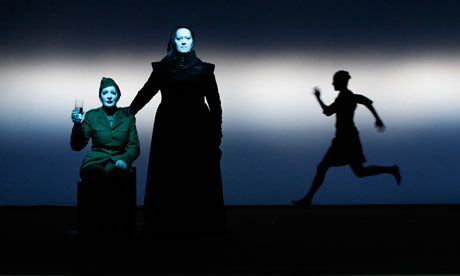
Having only heard and read about, but not experienced, any of Abramović's famous performance works, I went to see the Robert Wilson production of her "autobiography" without too much preconceived expectations of what I should be seeing. I have to admit, experientially, it felt much more like attending conventional theatre than being in the middle of a performance piece. Still, as I took my seat, the sight of three black dogs milling about on stage amidst three "coffins" with the artist's face on them was bizarre enough that it left an immediate impact. The piece did not focus too much on the artist's works (only two black-and-white footage which at different times hovered above the stage, one of a skeleton pressing upon a young woman and the other of a needle moving close, too close, to an open eye, vaguely recalled the bodily violence of A's early works), but much more on her actual life: family history, childhood, love affairs. In fact, the most poignant moment seems to be about her bidding goodbye to her work, her presence becoming an apotheosis, from martyr to symbol to saint. Her presence throughout the piece seems strangely distant, almost immaterial. Is the artist now absent?
What left the most impact on me, not surprisingly, were Antony Hegarty's beatific voice soaring into the ether and Willem Defoe's indefatigable presence as the narrator who sometimes got into the middle of the action, whether as a dancing Serbian officer or A's one time lover and collaborator Ulay. Still, I was greedy for more. The production was truly a feast for the eyes and ears, but the rest of my body both dreaded and wanted more, but it was mostly left alone.

What left the most impact on me, not surprisingly, were Antony Hegarty's beatific voice soaring into the ether and Willem Defoe's indefatigable presence as the narrator who sometimes got into the middle of the action, whether as a dancing Serbian officer or A's one time lover and collaborator Ulay. Still, I was greedy for more. The production was truly a feast for the eyes and ears, but the rest of my body both dreaded and wanted more, but it was mostly left alone.
Saturday, June 23, 2012
EYE of Amsterdam
I visited the new EYE film museum in Amsterdam for the first time on Tuesday. Although I miss the old film museum in the middle of Vondel Park, I have to admit this new venue is an impressive piece of architecture. Located right across the Ij from the Central Station, it is remaking the formerly quiet North into a veritable culture centre. Apparently, the famed Paradiso concert hall will also have an extension next to the museum in the future. It certainly looks like those cute little free ferries that whisk passgengers across the Ij will soon be a hub for music and movie fans' postmortem discussions!

Tuesday, April 17, 2012
街の戀
電影<窈窕淑女>中,有這一幕經典戲:一個男生愛上了女主角,在她住宅的街上徘徊,面對自己平常諳熟卻不大在意的街景,突然發生了濃厚的感情,花香鳥鳴,他都為之驚艷,一時流連忘返。
現實生活中,愛上一條街,有時比愛上一個人更加動人。失去一條街,亦可以比失戀更令人心碎。尤其在急速發展下的現代城市,街道好像每天都在改變,長年生活在它懷抱中,會有一種老戀人的焦慮。愈熟悉的在眼下愈變得陌生,往下去,終有面目全非、縱使相逢應不識的一天吧?
溫哥華的街道,算是一個比較溫柔、長情的戀人。我住在市中心 West End 多年,目睹不少大型的發展工程。然而,區內某些風情,不那麼容易抹殺到。沒有人會因上獅門橋的交通阻塞提議在史丹利公園裡加建公路。Coal Habour 儘管豪宅臨立,沿海長長的行人徑,依舊是屬於大家的公共空間。這區的樓價當然昂貴,但舊有的公寓,沒有被全數拆掉,住在區內多年的長者,亦不用因此搬走。較便宜的租價,更吸引了不少從韓國和日本來加學英文的年輕學生。亦新猶舊,才有混雜有趣的街景,才能維繫人與街微妙的感情。
在香港長大,對街道投注感情,倒像愛上一個薄倖的負心人。我小時常聽母親提到,她兒時的家在通菜街,是一條很恬靜的街,附近有很多山地,還有佔地很廣的東方煙廠,和母親最喜歡去的麗斯戲院和百老匯戲院。後來我才知道,原來攤檔林立、人潮濟湧的女人街,竟然是通菜街的舊址。母親記憶中的街道,名不存實也亡。正如學者周蕾所說,香港很多地方,不但人面全非,就連桃花也不能依舊!
我在土瓜灣長大,算是一個還沒有全被發展掉的老區,很多熟識的風光,仍留下蛛絲馬跡。我小時住了十多年的街,叫作靠背壟道,如其名,本來是一條靠著山壟的大街,我也依稀記得從家裡望出去,是一片連綿的高山。七十年代,爆山開地,山景變成一棟棟屋邨大樓。靠背壟道,早已沒有山壟可靠,應改名為靠高樓道!
電影<胭脂扣>中,也有這麼一場經典戲:女鬼如花回到陽間,在街道上蹓躂,看到八十年代西環的天橋大樓,灰灰沈沈的畫面,穿插於她回憶中石塘咀妓寨的繁華風月。同一個空間,卻無法把兩個年代聯繫起來。薄情的十二少,辜負了如花的癡情。不顧保育的城市政策,也在辜負著市民與街道互相牽動的情愫。

Subscribe to:
Posts (Atom)